It’s your baby’s first Christmas or birthday. Family members keep asking what to buy, and your home already feels full of baby gear. These are the most common issues in most families.
Australian families spend around $391 per person on Christmas gifts. With a baby, costs rise fast.
Loved ones bring plenty of presents; it’s hard to say no, and your baby often ends up more interested in the wrapping paper anyway.
That’s exactly the problem the 4 gift rule was built to solve.
So What Actually Is the 4 Gift Rule?
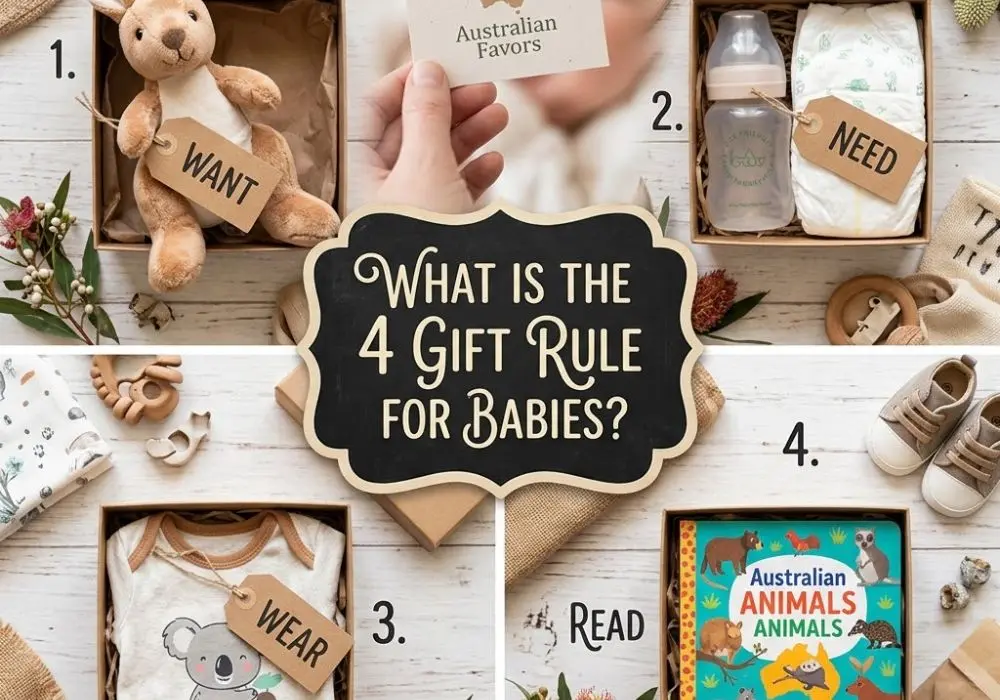
The 4 gift rule is simple. Each child receives four presents, each fitting into one of four specific categories. Something they want, something they need, something to wear, and something to read.
That’s it. Four gifts. One from each category.
The idea originated in the United States and spread through parenting communities online. It eventually found a strong following in Australia, including groups like the Kmart Mums Facebook community, where parents began debating whether it could work for their families.
It sounds almost too simple. But the elegance is in what it removes: the pressure to outdo yourself, the guilt of buying too little, and the chaos of your baby being completely overwhelmed before lunchtime.
How to Apply Each Category to a Baby
Something They Want
For babies, treat “want” as play that suits their stage. Focus on what they can use now, not later. A three-month-old does well with black and white cards or a simple rattle. A ten-month-old who is pulling up may enjoy a push walker. A one-year-old needs toys that are safe, chunky, and easy to grip.
Choose toys that meet Australian Safety Standards. Texture and grip matter more than how a toy looks online. Skip flashy electronic toys. The best ones respond to the baby’s actions.
Something They Need
This is the easiest and often the most useful category. Think nappies, a baby carrier, muslin wraps, or a white noise machine. Practical feeding items like silicone bibs, suction bowls, or a starter cutlery set are also helpful and affordable.
In Australia, popular practical picks such as the Ergobaby Omni 360 (typically $300–$389 AUD at major Australian retailers or a set of flat nappies if the family is doing cloth.
If the baby has just hit the feeding stage, a set of silicone bibs, suction bowl sets, or a Doddl starter cutlery set is genuinely useful and under $40.
The “need” gift is also a smart place to direct relatives who insist on buying something. Give them a specific item and a direct link. It helps everyone.
Something to Wear
Christmas falls in summer, so choose light and practical clothing. Go for UV swimwear, cotton rompers, or a good sun hat. For winter, merino wool bodysuits work well and last longer.
Size up by at least one size when buying baby clothing as a gift. Babies grow fast, and clothes can become too small within weeks.
Something to Read
This matters more than most people think. Reading from birth supports language and bonding.
Research consistently shows that early literacy is a key predictor of school readiness, a finding supported by Australian child development organisations, including the Raising Children Network.
For newborns to six months, high-contrast board books with simple shapes are ideal. For six to twelve months, chunky board books with textures and flaps work well. For one-year-olds, anything with repetitive language and simple illustrations is gold, think Mem Fox’s Possum Magic or Diary of a Wombat by Jackie French, both Australian classics that hold up through years of re-reading.
Does It Actually Make Sense for Babies?
Most advice focuses on older kids who can talk, make wishlists, or choose between characters like Thomas or Bluey. Babies are different.
A six-month-old does not “want” specific items. They want your attention. They explore simple objects like spoons. They are not asking for gifts.
The 4 gift rule for babies is not about what the baby wants. It helps the adults. It sets clear limits, guides family members, and stops your home from filling up with excess.
A study by the University of Toledo, published in Infant Behavior and Development, found that toddlers with fewer toys played for longer periods and showed better focus.
This applies to babies, too. They benefit from less stimulation, not more.